
Leaving your dog home alone in the heat: what to set up before you go

Tessa Larkin · Writer, pet wellbeing and pet gear
Tessa lives with a Labrador and two cats on the Texas Gulf Coast, one of the hottest and most humid corners of the country in summer. For several seasons she has been testing, in real conditions, what actually helps animals through the heat and what only looks like it does.
The house at eight in the morning is not the house at three in the afternoon
Every piece of hot weather advice for dogs assumes somebody is in the room: watch the panting, refill the bowl, move them out of the sun. None of it happens between nine and six. And a home does not sit at one temperature. It climbs room by room and keeps climbing after the outdoor peak, because walls and floors take heat in slowly and give it back slowly. The coolest hour indoors is early morning; the worst is mid afternoon, very often the exact stretch the house is empty.
The PDSA sets out what a room like that can do. In its page on heatstroke in dogs, published in September 2023, the causes do not stop at exercise or vehicles: it can also be caused by simply sitting somewhere too warm, or being trapped somewhere hot, such as a car, conservatory or room without proper ventilation. A room appears there in the same sentence as a car, because a shut one with the sun on it stops being the room you left.
So check it at the hour you are never in it, with a thermometer on the floor rather than at head height. Cooling a dog while you are there is a different list, and it is in how to cool down a dog.
Which doors you leave open decides which floors they can reach
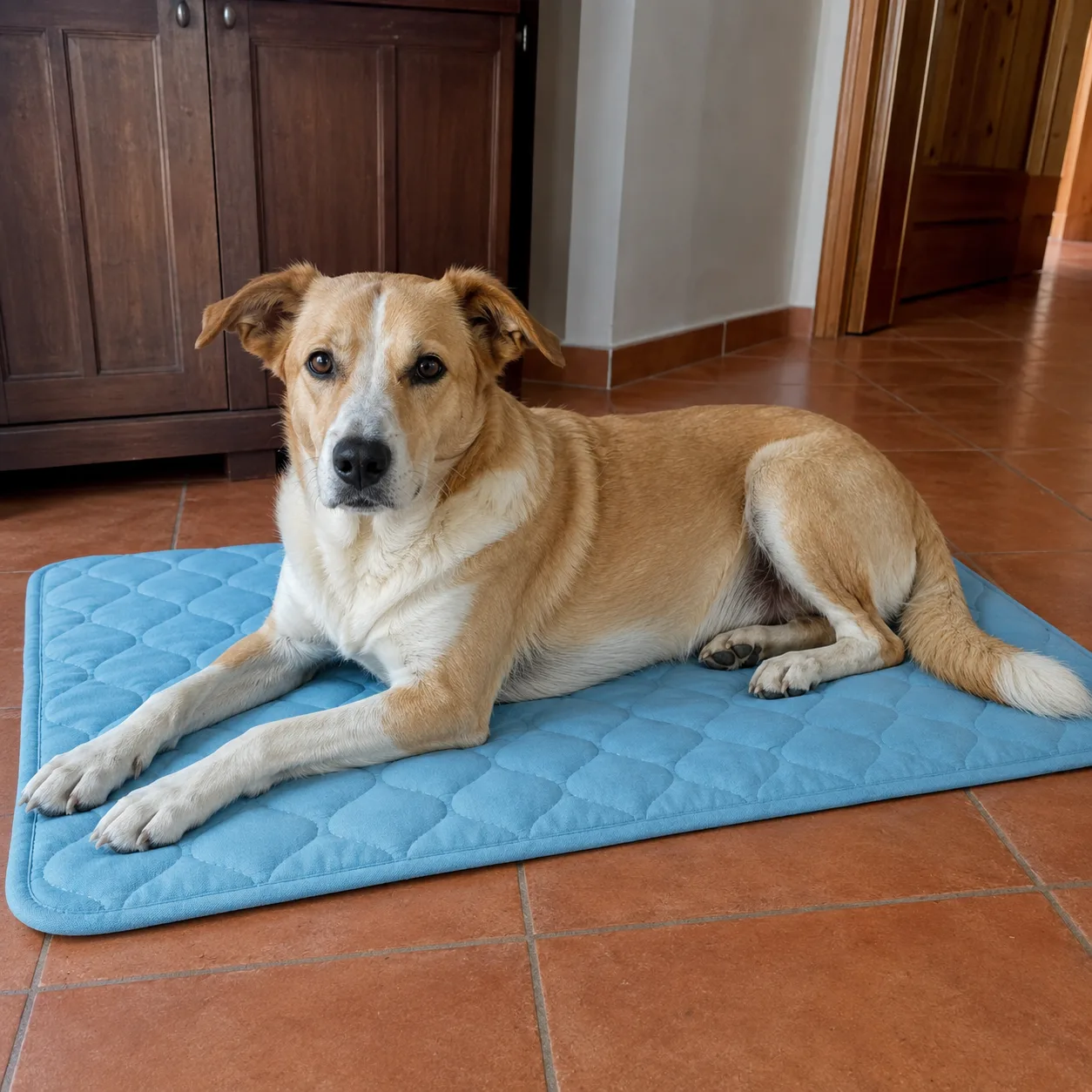
Ask any owner where their dog lies in summer and the answers repeat: the hall tile, the kitchen floor, the bathroom, the strip by the back door. Dogs shed heat through the underside of the body, so they go looking for hard, shaded floor, for the reasons set out in where to put a dog cooling mat in the house.
Then people close four doors on the way out. It is almost never a decision about heat: doors get shut so the dog stays off the bed or out of the office. In warm weather it quietly deletes most of the house from the list of places your dog can cool down in.
- Keep one hard floor reachable. Tile, stone, vinyl, sealed concrete, wood. Carpet gives heat nowhere to go.
- Prefer the lowest level and the shaded side. Ground floors, interior hallways and north facing rooms stay cooler than anything directly under a roof.
- Wedge those doors open. A door that swings shut in a draft can trap a dog in the room the air was leaving.
- Do not narrow it to one room unless you have to. A dog with two or three surfaces picks the right one all day.
If your dog is crated or gated into a single space, that space is the whole decision, and it earns the afternoon check.
Windows and shades get set once, for the afternoon
Glass is where most of the heat gets into a house, and it is the setting people get backwards because they set it on the way out. Work out, once, which windows take sun during the hottest part of the day, and shade those before you go: blinds, curtains, shutters, an outside awning, anything that stops the light at or before the glass. The rest can be left clear. Done once, it is the same setting on every warm day after. What changes when you are out is that nobody comes back at noon to finish the job.
One more thing about windows has nothing to do with temperature. In its hot weather guidance the ASPCA tells owners to keep unscreened windows and doors closed and to make sure adjustable screens are tightly secured, and gives the reason in a line: "Open unscreened windows pose a real danger to pets, who often fall out of them." Air moving through the house does a lot on a warm day, and it does not justify an open unscreened window with a dog alone behind it.
Air that keeps moving with nobody there to move it
Dogs cool themselves mainly by panting, which works by evaporation, and evaporation slows when the humid air stays put. Air that keeps moving carries that humidity away and lets panting go on doing its job.
So it earns its place, and it helps to know how much it buys you. The Humane Society of the United States heads that part of its hot weather guidance with an instruction not to rely on a fan, and states that fans do not cool off pets as effectively as they do people. We cool by sweating across the whole skin surface, so air passing over us does continuous work. A dog does not have that.
Read it as an instruction about order: air movement is the second decision, the temperature of the room is the first. The version that keeps running is cross ventilation, two openings on different sides of the house with the doors between them left open. Same wedged door, second job, and it does not stop when the power does.
Water that has to last the whole day, not the first hour
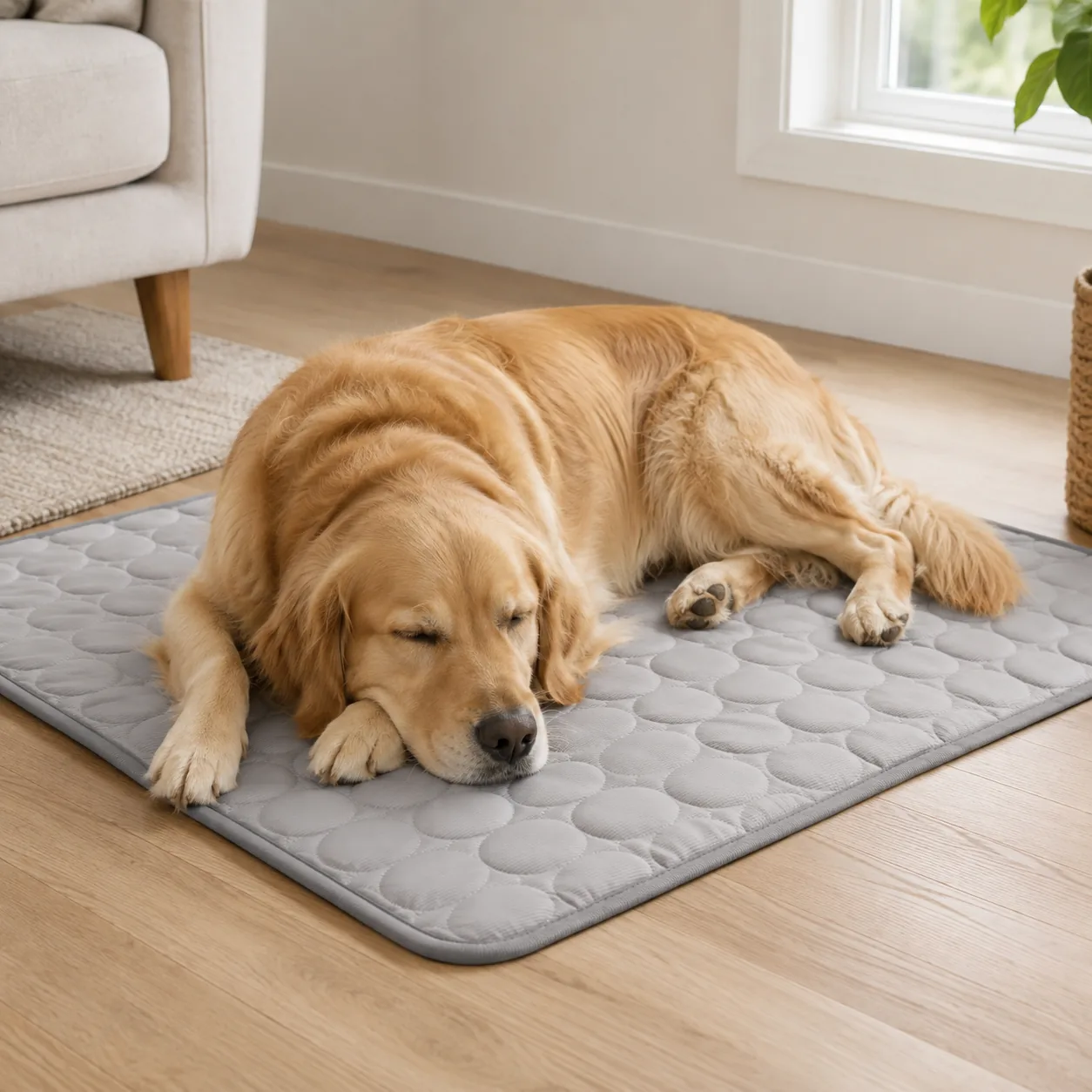
The ASPCA's line on water is short and it is about quantity: give pets plenty of fresh, clean water when it is hot or humid outdoors, as pets can get dehydrated quickly. When you are home, that is a bowl and an eye on it. When you are out for nine hours, one bowl is one point of failure: tipped by a paw at half past ten, pushed under a cabinet, or standing where the floor turns into full sun by two.
- More than one bowl, in different rooms, so a knocked over bowl is not the end of the water.
- Wide and heavy beats tall and light. A low, broad bowl with weight in the base is far harder to tip.
- Out of the sun, and out of its path, because the sunny patch moves.
- Not ice cold. Water at room temperature gets drunk more readily, which matters when nobody is there to encourage it.
It matters most for older dogs, whose thirst signaling gets less reliable with age: senior dogs and cats in summer.
What a camera tells you, and what it cannot do
Plenty of households now watch the dog from a phone, sometimes with a thermometer in the room. It is useful for one thing: it tells you what is happening. A feed showing hard, continuous panting tells you something needs to happen, not what or by whom. The monitoring is only as good as the plan attached to it: someone with a key who can be there quickly, or the decision to come back yourself.
It is also where the failure people forget shows up. The Humane Society of the United States advises owners to plan for outages before a summer storm takes out the power, so pets stay safe from heat stroke and other temperature-related trouble. Anything electrical stops when the power does, camera included. What keeps working is the shaded window, the wedged door, the bowls, and the surface your dog is lying on.
A camera will not read your dog for you either: how to tell if a dog is too hot takes the changes in the order they appear.
The last pass before you close the door
This is the two minute version you run on the way out.
| Before you leave | What it is for |
|---|---|
| Shades down on the glass that takes afternoon sun | Stops the heat at the window instead of dealing with it later |
| Interior doors open and wedged | Keeps the cool floors reachable and lets air travel between them |
| Unscreened windows closed, screens secured | The ASPCA warning: open unscreened windows are a fall risk for pets |
| Two or more bowls, wide, heavy, in shade | One tipped bowl stops being the end of the water |
| A cool surface on the floor they use | Somewhere to lie that takes heat away rather than holding it |
| Nothing pending outdoors | No dog in a yard without shade, and never in a parked car |
The last row is the one to read twice. The ASPCA states it without qualification: never leave your animals alone in a parked vehicle. Nothing you can put in a car changes it.
The one item in the room that asks nothing of anybody
Look back at the list. Shade set in advance, doors wedged in advance, bowls filled in advance. The setup holds because none of it needs a second visit.
That is the specification a cooling surface has to meet in an empty house, and it is where the technologies part company. A gel mat holds a reserve of cold that runs down and then needs a break. A water filled mat needs filling. A freezer type needs the freezer and someone to make the swap. Each is built around a person being in the building.
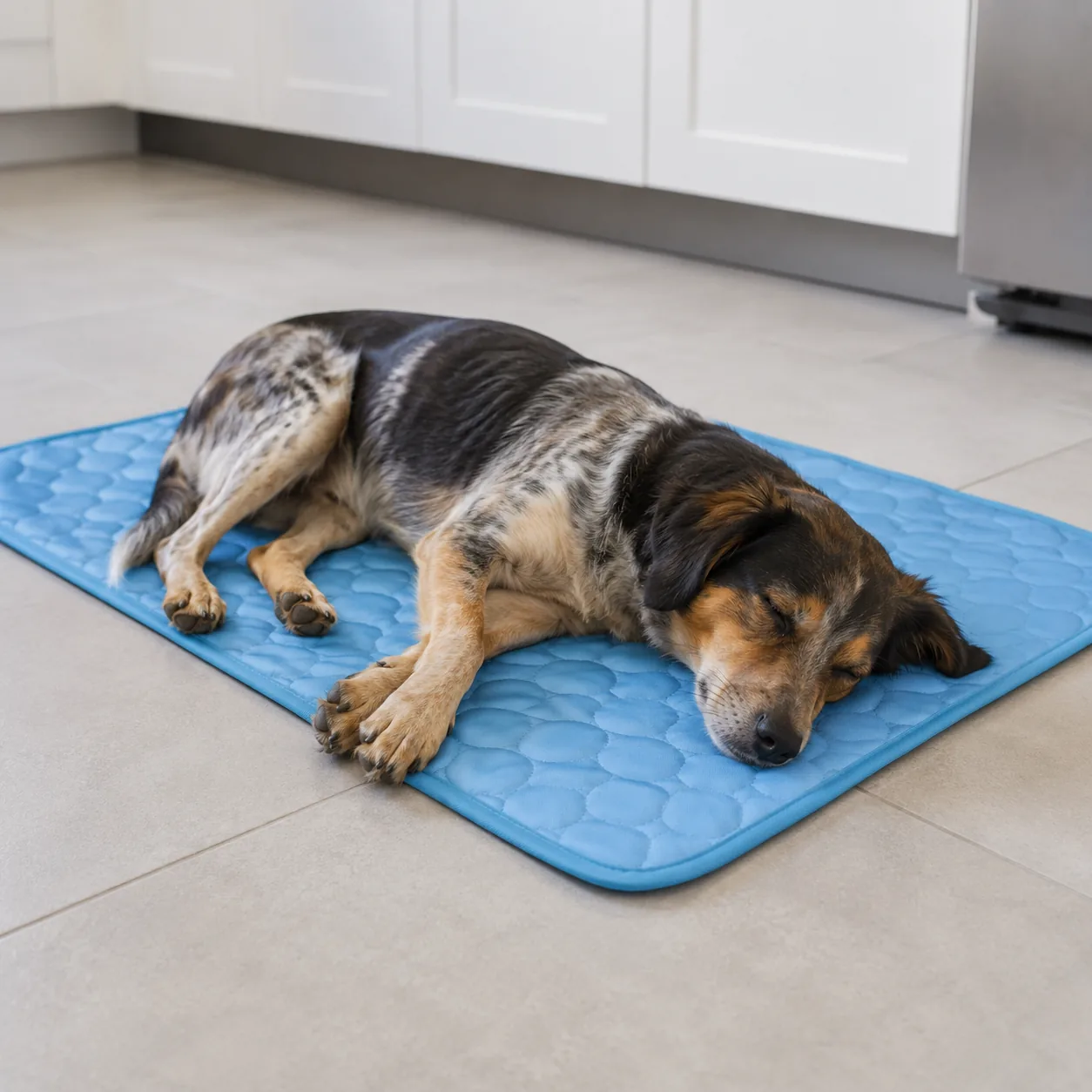
The Frimouf Ice mat is ice silk, which does none of that. No gel, no water, no power, nothing to pre chill: the 75 percent polyamide top layer takes body heat by conduction and lets it go through the breathable mesh underneath. The same fabric at four in the afternoon as at eight in the morning, because there is no charge in it to run down. The physics, with the surface reading we took with an infrared thermometer, is on how dog cooling mats work.
Be exact about what that means. The mat is a surface. It is not a safeguard, and it does not stand in for a single line of the checklist above. What decides whether the day goes well is the room. The mat decides what your dog is lying on inside it.
Which is also why more than one gets used. A dog left alone moves as the house changes, and a mat in the hall and a mat in the kitchen means the cool surface is already wherever they end up. Sizing goes by weight rather than breed, and the size guide gives the number.
Frequently asked questions
How do I keep my dog cool while I am at work?
You decide it before you leave, because nothing gets adjusted once the door is closed: access to the coolest hard floor in the house, shade on the windows that will take the afternoon sun, a path for air to move between two openings, and water in more than one place.
Is a fan enough on its own when nobody is home?
It is one part, not the plan. The Humane Society of the United States heads that section of its hot weather guidance with an instruction not to rely on a fan, and states that fans do not cool off pets as effectively as they do people. Moving air helps a panting dog, and it does nothing about a room that is simply too warm.
What if the power goes out while I am away?
The Humane Society of the United States treats it as a real scenario, advising owners to make a plan before a summer storm takes out the power. What does not stop with the electricity is a shaded room, a wedged interior door, water in several bowls and a surface that needs no power to work.
How long can a dog be left alone in warm weather?
No veterinary body publishes a number of hours, and any figure you find online is somebody’s estimate rather than a measurement. What decides it is the room and the dog: how hot the space gets at its worst hour, whether air moves through it, and how much water is within reach.
Symptoms of overheating, the unscreened window warning and the parked vehicle rule as published by the ASPCA in "Hot Weather Safety Tips". Guidance on fans, on power outages and the instruction to take an affected pet directly to a veterinarian as published by the Humane Society of the United States in "Keep pets safe in the heat". Causes of heatstroke and the instruction to call your vet as soon as possible as published by the PDSA in "Heatstroke in dogs", September 2023. This text does not replace veterinary advice. If you suspect heatstroke, contact a veterinary practice or an emergency service straight away.
The part of the setup that needs no one
A cool surface that works the same at four in the afternoon as at eight in the morning. No gel, no water, no power, nothing to freeze.
Free shipping to 18 countries · 30-day returns · We reply within 24 hours