
Gel-free cooling mats: what is behind the worry

Tessa Larkin · Writer, pet wellbeing and pet gear
Tessa lives with a Labrador and two cats on the Texas Gulf Coast, one of the hottest and most humid corners of the country in summer. For several seasons she has been testing, in real conditions, what actually helps animals through the heat and what only looks like it does.
What people are actually afraid of
The searches are very precise and they all describe the same scene: the dog is left alone in a room, gets bored, starts chewing, and at some point the casing opens.
It is not an invented worry, and it is always the same one: is it dangerous?, is it toxic?. Notice what the question lands on, though. Not the mat, but what the mat has inside it.
One detail is worth noticing: almost the whole market sells gel. Every seller we opened on this search offers gel or water-filled mats. So the most widespread worry is about the most widespread construction.
The right question is not “is the gel toxic”, it is “does the gel stay inside?”
Almost every discussion of this starts off wrong, because it focuses on the chemical make-up of the gel. That is the reassuring part of the problem, and we will come to it. The part that actually matters is a different one, and it is mechanical.
A gel mat is a pouch. While the pouch is closed, nothing happens. When it opens, and it opens for the most ordinary reasons, a claw, a tooth, a seam that gives way after a summer, the weight of a big dog always in the same spot, the gel comes out. From there the sequence is always the same: it ends up in the coat, the animal grooms itself, and what was in the coat ends up in the mouth.
There is another constraint on gel that gets little attention, and it is not us saying it: the listings write it themselves. The gel runs out. After roughly three or four hours of continuous use the effect drops, and the mat has to be left unused so the gel can regenerate. On a 91 °F day, three or four hours covers the afternoon and no more: at the moment your dog would need it most, the mat is resting.
The Frimouf Ice has no reserve to recharge, so it has no break to respect either. It stays cool because of how it is made rather than what it contains: the polyamide on top conducts heat away and the mesh underneath lets it out, for as long as your animal is on it. As soon as they shift, that patch is cool again within minutes.
On top of that comes the piece that gets talked about least, and it is the most serious: swallowed fragments of film and plastic are more dangerous to the gut than the gel they contained. An obstruction has nothing to do with the toxicity of a food thickener, and it is not solved with a glass of water.
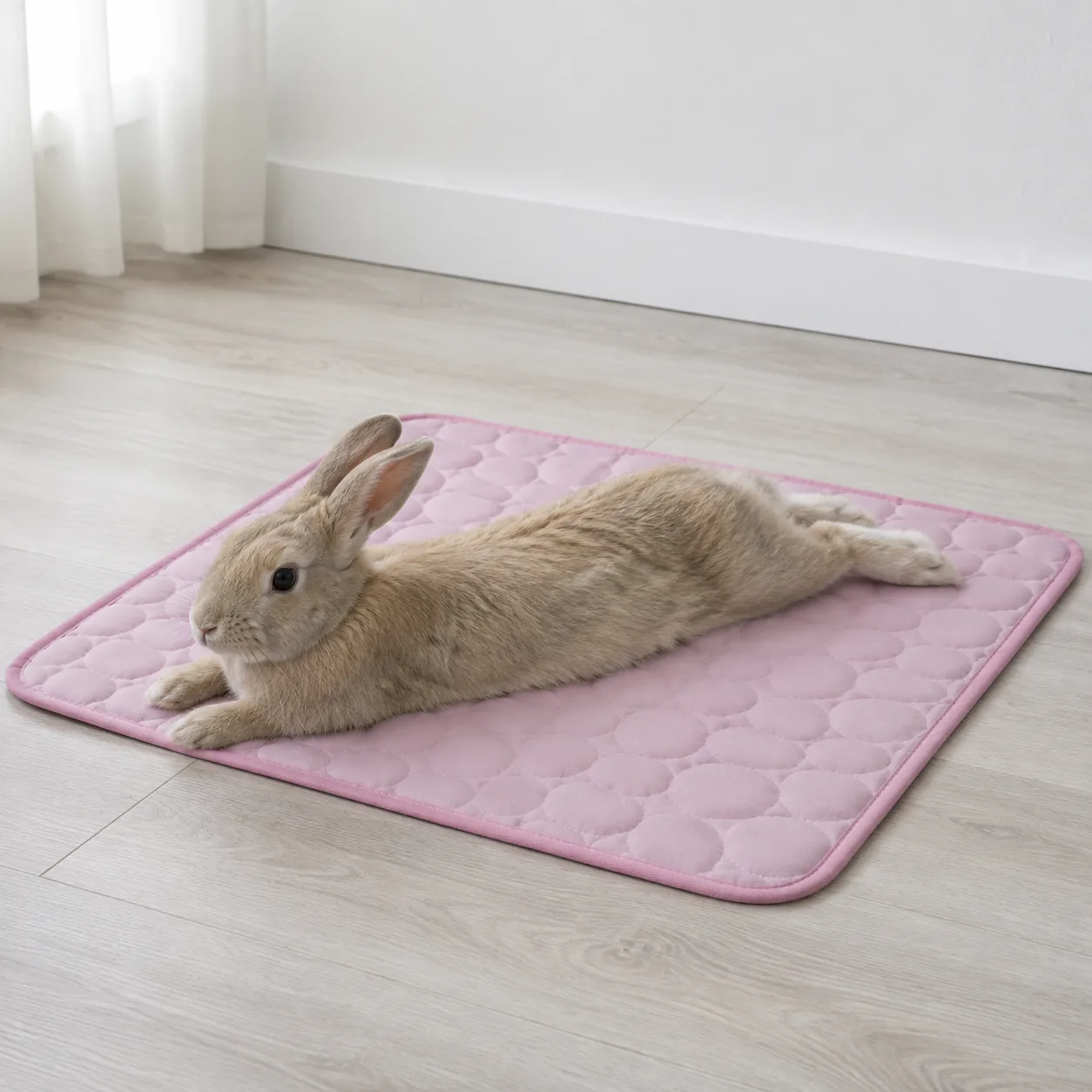
Which is why our answer to "is it dangerous?" is not "our gel is safer". We have no gel. There is no pouch, so there is nothing that can open, leak, be licked or be swallowed. The risk this whole page is about simply does not exist on our product.
The problem with gel is not the formula, it is that nobody states it
Cooling gels on the market are not all the same, and that is already half the issue: hardly any product states which gel it actually contains. While the pouch stays shut that has no consequences. The moment it opens, it becomes the first question your vet asks you, and you have nothing to answer.
The second point is about the animal rather than the product: allergies and existing conditions are individual. A "harmless" that holds for every dog and every cat does not exist, and it is not something you want to find out about on your own.
Which is why one kind of phrase is worth stopping on wherever you read it: "the gel inside is 100% safe, for people and for animals". A seller can say which gel it is. They can say it is approved as a food additive. They can say documented incidents are rare. "100% safe" is something else, and nobody can guarantee it for your dog in particular.
If something has already happened, the same rules apply as for any swallowed foreign body: clear the residue from the mouth, offer water, do not induce vomiting, and call the vet. Take the packaging with you.
Why the question does not arise with ice silk
Our mat contains no filling liquid. It is three layers of fabric stitched together, and the cooling does not come from a reserve but from the fiber itself: polyamide conducts heat, cotton and polyester barely do. That is why it needs no gel, no water and no power. The principle is explained in full on the page about how cooling mats work.
Material composition
| Top layer | 75% polyamide, 25% polyester |
|---|---|
| Filling | 100% cotton |
| Bottom layer | 100% polyester |
Read off the label of an actual unit, not copied from a spec sheet.
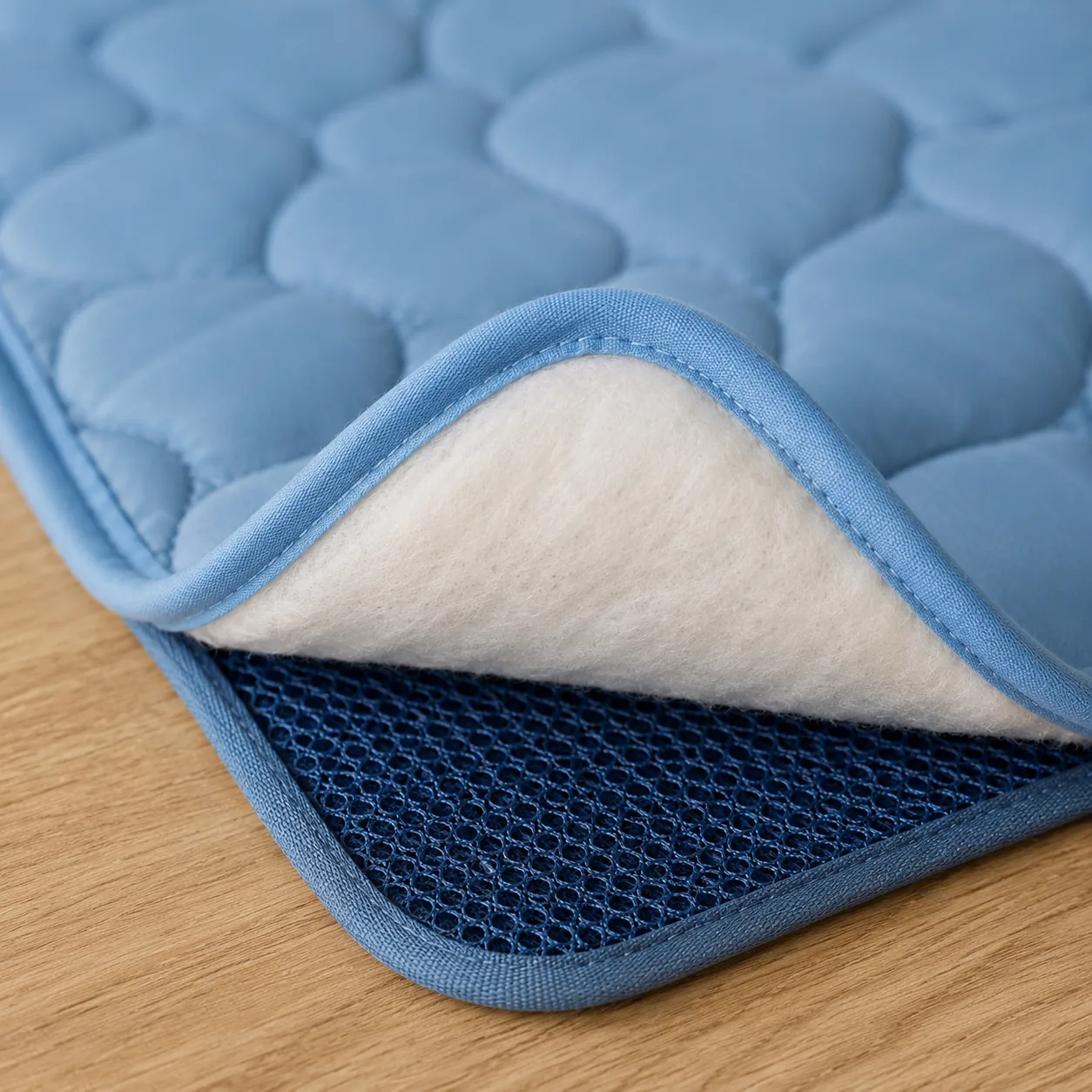
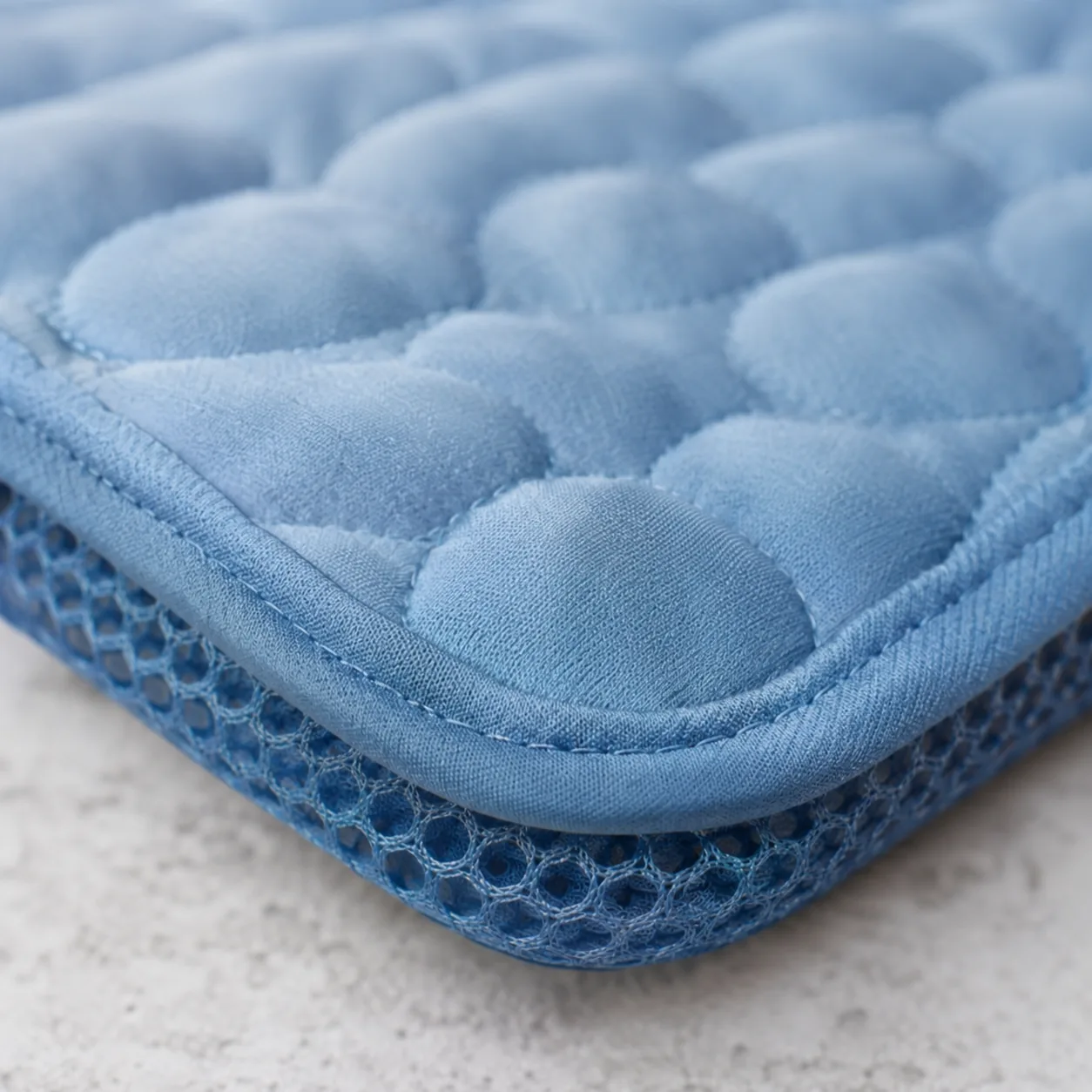
If your dog gets its teeth into it, they can pull fibers out, as they could from any blanket. Nothing comes out, nothing leaks, and there is no film to swallow. That is the whole difference, and it is not a small one.
The one line almost nobody prints
There is one line that decides whether you can judge a cooling mat at all, and it is the fiber composition in percentages, given on the product page rather than on a tag you read afterwards. Not "polyester", not "high-quality material": the percentages. Without them nobody can explain why the mat should cool, and you cannot compare two products that use the same word for completely different fabrics.
It also happens to be the line that tells you what your animal would be chewing on. A seller who states the composition has thought about both questions. One who does not, has answered neither.
Check it yourself, it takes two minutes. Open three cooling mat listings, whichever you like, and look for the fiber percentage of the top layer. Not the color, not the dimensions, not "high-quality material": the percentage. It is the one figure that lets you understand both why a mat should cool and what happens if your animal bites it.
We read ours off the label of a physical unit and put it on every product page, not in small print at the bottom.
The second safety point almost nobody raises: temperature
With freezer mats and cooling packs there is a real issue: too cold, on too small a surface, for too long. With small animals, puppies and older dogs in particular that can go from uncomfortable to harmful, which is why products like that should always be used with a cloth in between and under supervision.
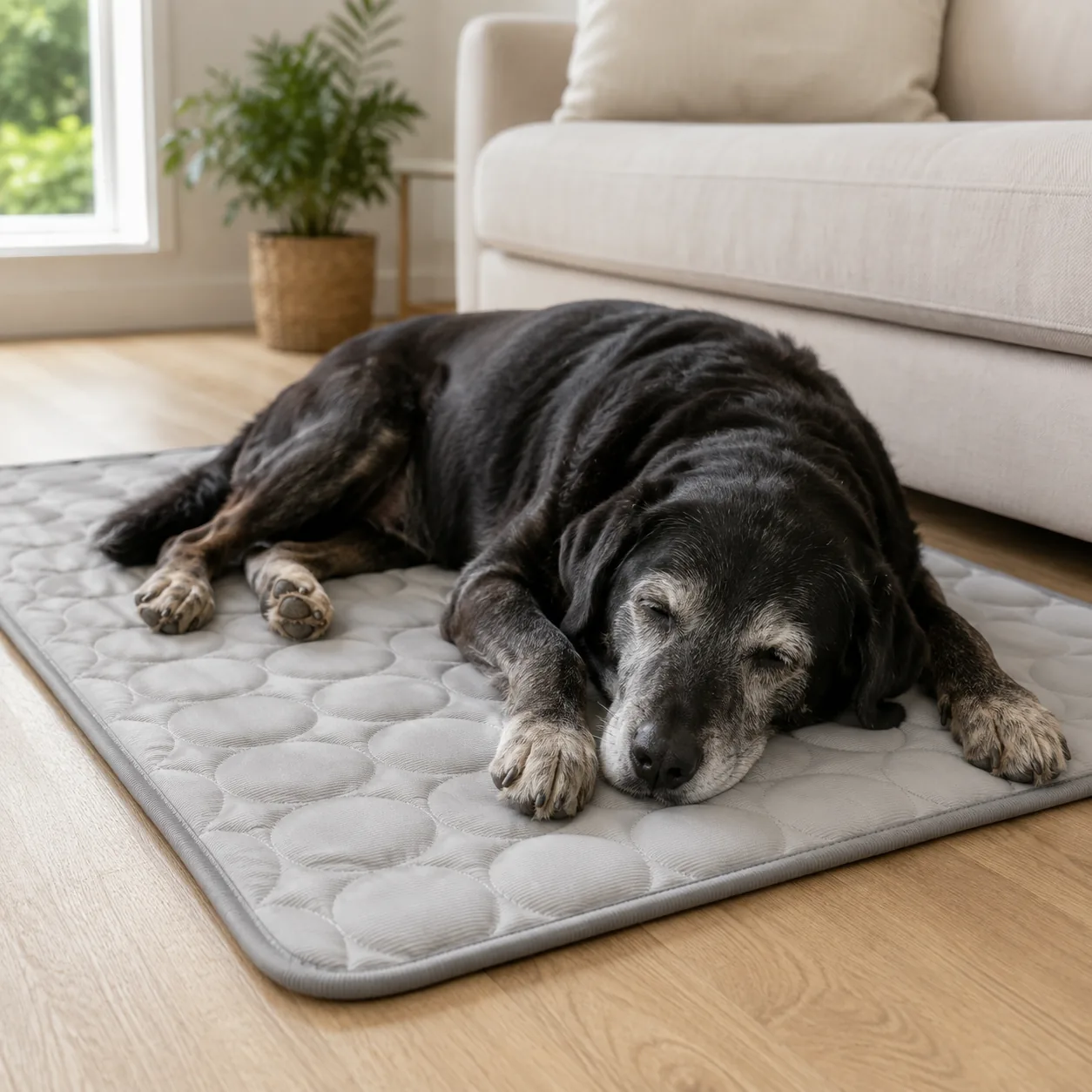
A passive ice silk mat does not have that problem, because it never gets colder than the room. There is no maximum recommended time and nothing to watch. Your animal stays on it for as long as it suits them.
Three questions to ask anyone selling a cooling mat
What is the top layer made of, in percentages? If a clear answer does not come back, the seller does not know either.
What happens if my animal bites it? With a gel mat the only answer is that the gel comes out. Anyone who denies it is telling you a story.
How long can they stay on it unsupervised? If a time limit has to be given, then stored cold is involved, and something needs to go in between.
Frequently asked questions about safety
Are dog cooling mats toxic?
With an ice silk mat the question does not come up: there is no filling liquid that can escape, only layers of fabric stitched together. With gel mats it depends which gel is inside, and that is exactly the problem, because almost no product page says. If your dog swallows some, you have nothing to tell the vet on the phone.
What happens if my dog chews through it?
Out of a gel mat comes gel, which spreads through the coat and ends up in the mouth during grooming. A dog can also swallow pieces of the film, which mechanically are more of a risk than the gel itself. Out of our mat a dog can pull fibers, as with any blanket, but nothing escapes.
Is it safe for cats?
Cats knead with their claws and chew fabric, so with gel mats the concern is even more justified than with dogs. On top of that a cat grooms thoroughly, so anything that clings to the coat ends up in the stomach. A mat with no filling liquid sidesteps the question entirely.
Can my pet get too cold lying on it?
No. An ice silk mat never gets colder than the room, it only conducts heat away. So there is no cold your animal is exposed to, and no maximum time. It is a different story with freezer mats or chilled packs, where prolonged skin contact really can be too cold.
What is inside a cooling mat?
Ours: top layer 75% polyamide and 25% polyester, 100% cotton filling, 100% polyester underside. That disclosure is not an optional courtesy, it is required by law under the FTC Textile Fiber Products Identification Act. When it is missing, that is a failure to disclose, not a trade secret.
Can I leave my pet on it unsupervised?
Yes. There is nothing to supervise, because there is nothing inside: no pouch that can open, no liquid to lick, no film to swallow. With a puppy in the phase where everything goes in the mouth, apply the normal caution you would with any fabric: leave something to chew next to it, so the mat stays the place where they lie down.
This page does not replace advice from a vet. If you suspect poisoning, or that your animal has swallowed something it should not have, call a vet or an emergency animal clinic straight away.
No gel, no liquid, nothing that can get out
Three stitched layers of fabric, composition stated on every product page. Four sizes, four colors.
Free shipping to 18 countries · 30-day returns · We reply within 24 hours