
How long does the cooling really last?

Tessa Larkin · Writer, pet wellbeing and pet gear
Tessa lives with a Labrador and two cats on the Texas Gulf Coast, one of the hottest and most humid corners of the country in summer. For several seasons she has been testing, in real conditions, what actually helps animals through the heat and what only looks like it does.
Why this question keeps coming up
It shows up in the FAQ of several sellers, and it gets searched in plain words: how long does a dog cooling mat last. The reason is simple. Almost every listing promises cooling, and almost none of them says for how long.
Anyone who has owned a gel mat knows the feeling: by the afternoon it is not cold any more, and you start wondering whether it is broken.
It is not broken. But the answer depends on which construction you have at home, and the two constructions stop in completely different ways.
With gel: three or four hours, then a break
A gel mat works like a tank. The gel takes in heat until it has warmed up itself. From there it cannot absorb any more, and it has to cool down before it works again.
That is not us saying so: it is written on the product listings, which give "a duration of 3 to 4 hours of constant use" and then tell you to leave the mat unused so the gel can regenerate.
Three things rarely appear together on a sales page. First, there is no single number that holds for everyone: size, number of chambers and gel thickness all change the result. Second, the duration depends on the room temperature as well, not only on the product. Third, output drops with continuous use, which means that on the very day your dog needs it most, the mat performs worst.
With ice silk: not a duration, a cycle
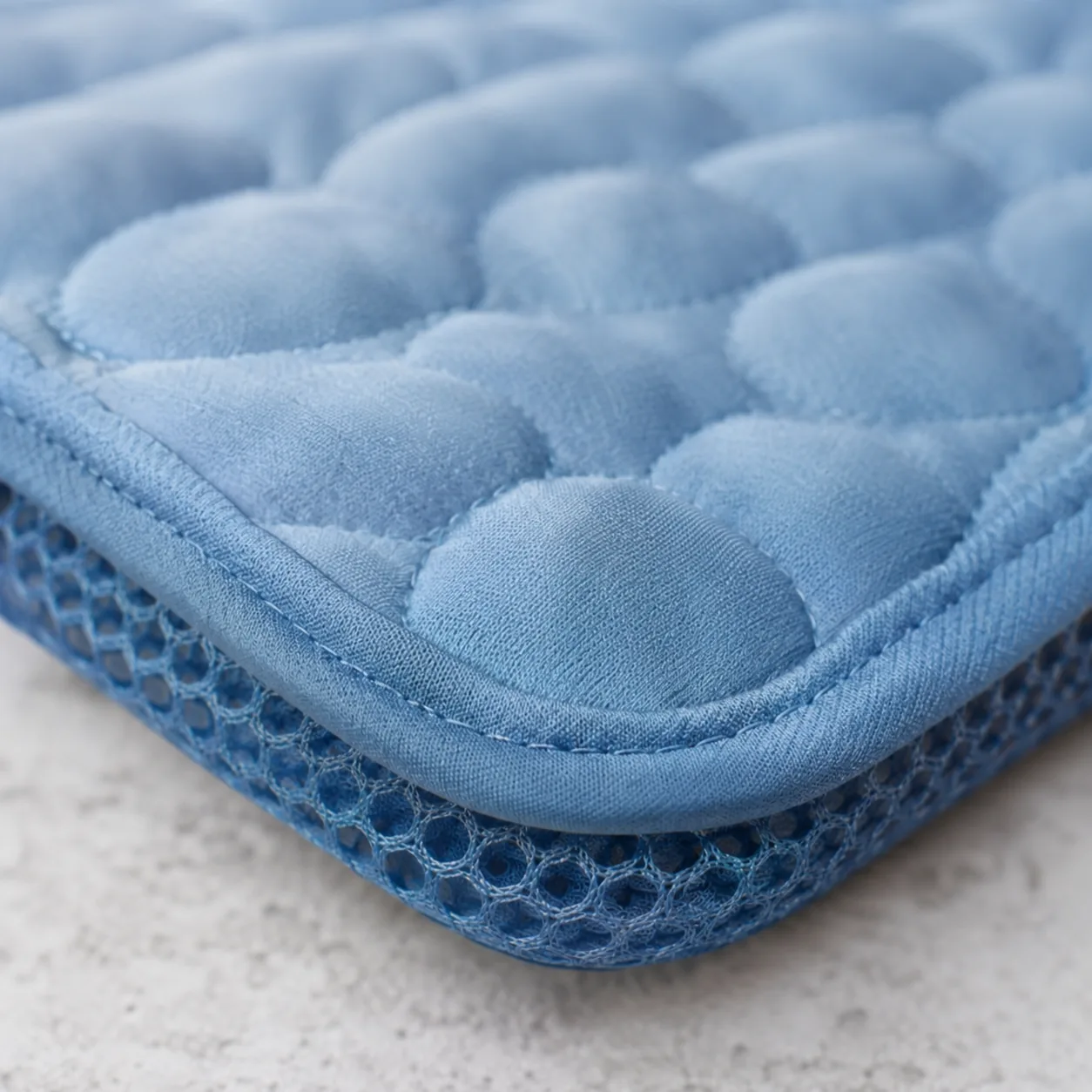
An ice silk mat stores nothing. It conducts. The fibre takes up body heat and spreads it across the surface and into the mesh on the underside, where it is handed off to the air. The detail is on the page about how cooling mats work.
One consequence matters: there is no reserve running down, so there is nothing to recharge and no break to respect. The effect has no point at which it ends.
What does drop is the output directly under an animal that has not moved for hours. The moment they get up, turn over or shift, that surface is cool again within a few minutes. It is exactly what you see every summer with any dog on a tile floor: lie down, get up, settle again a hand's width further along.
A cooling number means nothing until you say what it is measured against
You will read "up to 10 degrees cooler than the surrounding area" on more than one listing. That figure is not absurd, and this is where most comparisons go wrong. It depends entirely on what the surrounding area is.
No passive mat can be colder than the air in the room. Nothing without a power supply can. But a mat can easily be cooler than the floor, because the floor under a dog has been warmed by the dog. That is the comparison worth making, and it is the one we made.
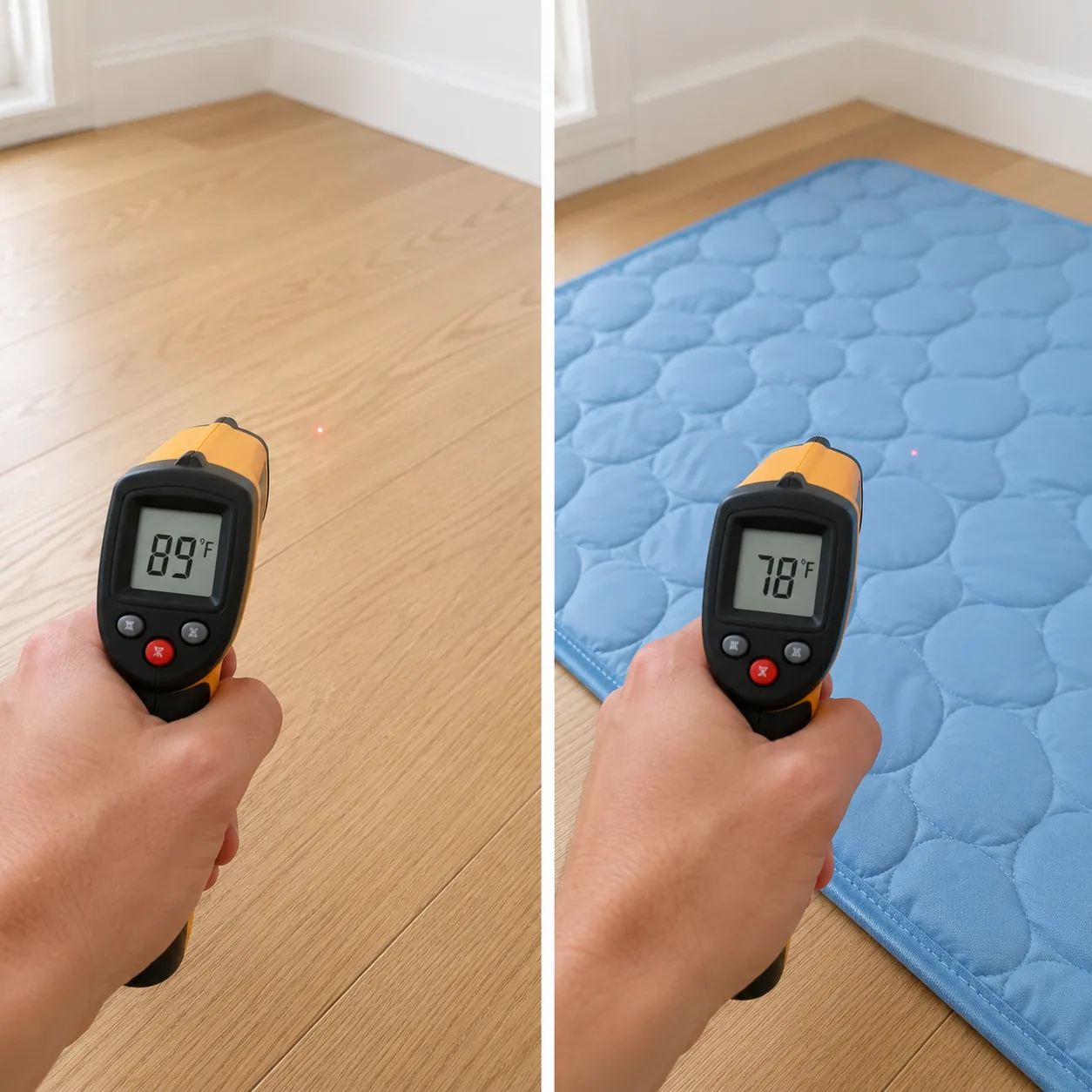
Same room, same minute, infrared thermometer: 89 °F on the floor, 78 °F on the mat. An 11 °F gap, measured rather than claimed.
So the test is not how big the number is. It is whether anyone tells you where the thermometer was pointed. A figure given against "the surrounding area" can mean the floor, the air, or nothing in particular. Ours was pointed at the bare floor and at the mat, in the same room, and both readings are printed above so you can check the gap yourself.
The factor almost nobody names: room temperature
The output of any passive mat depends directly on how much distance there is between the room temperature and your pet's body temperature. A dog runs at about 101.5 °F.
| Room temperature | Gap to a dog's body temperature (about 101.5 °F) | What you notice |
|---|---|---|
| 72 °F | about 30 degrees | clear effect, holds for a long time |
| 82 °F | about 20 degrees | plainly noticeable, the dog shifts more often |
| 95 °F | about 6 degrees | the mat works alongside shade and moving air |
This table holds for any passive mat, whatever the brand and whatever the technology. It is also why the same mat feels impressive in June and ordinary in an August heat wave: nothing about the mat changed, the room did. What to do when the numbers really climb is in the article on how to cool down a dog: air out early, shade during the day, keep air moving.
Two questions people often confuse
How long does it cool in a day? That is the question above. Answer: for as long as heat can flow away, and it depends on movement and on the room temperature.
How many years does it last? Something else entirely. In gel and water mats it is the seam holding the filling in that ages, and leaking chambers are the usual reason people buy again after one to three summers. In a sewn fabric with no filling that weak point is not there, and what ages is the cloth. The difference between the constructions is explained in the article on gel or ice silk.
Three things that stretch the effect in practice
Take one size up. Not because a big mat stores more, but because your pet can shift and immediately find a spot that is still cool. Which size for which weight is in the size guide.
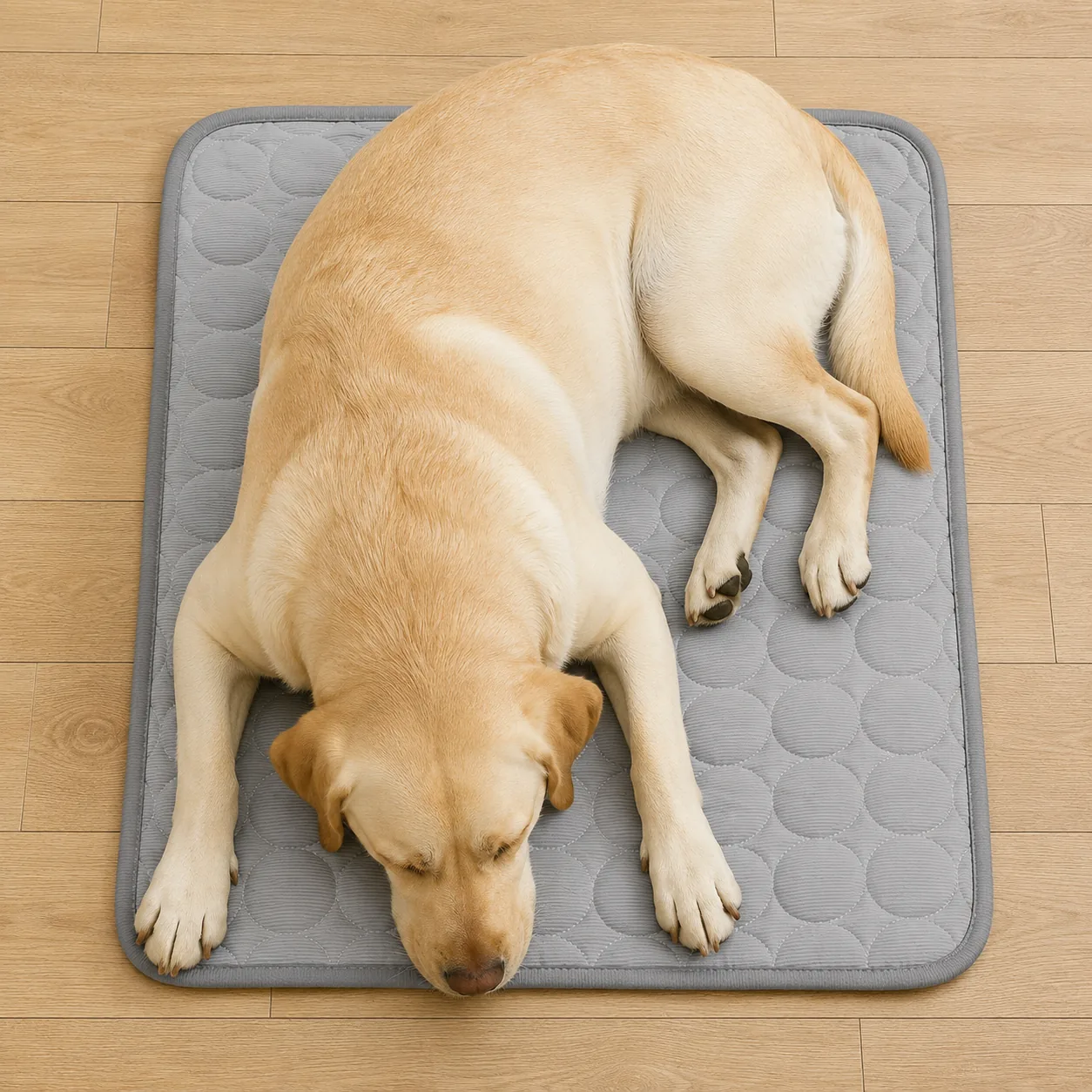
Do not put it on a rug. The heat has to be able to leave downward. On tile, stone or hardwood a mat performs far better than on thick carpet or on a padded bed that insulates from underneath.
Move the air above it. A fan circulating the room air does not only help your pet pant: it helps the mat too, carrying away the heat coming out of the mesh.
Frequently asked questions
How long does a cooling mat last?
With gel mats, according to the product listings themselves, three to four hours of continuous use, after which the gel has to be able to give its heat back up. With ice silk there is no fixed duration, because nothing is stored: it cools for as long as heat can flow away, and the effect returns every time your pet shifts position.
Why does the effect fade?
Because the temperature difference evens out. A mat cools by letting heat pass from your pet into the material. If they stay still in the same spot for a long time, that spot reaches their own temperature, and from there nothing flows any more. That is physics, not a fault in the product.
How many years does a mat last?
That is a different question from the one about the effect. In gel and water mats it is the filling, and the seam that has to hold it in, that age: leaks after one to three summers are the usual reason people replace them. In a sewn fabric with no filling that weak point does not exist, and what ages is the cloth.
Do I need to take it away now and then?
With gel, yes, it needs breaks before it can cool again. With ice silk, no. There is nothing to recharge, and since no cold is stored there is no maximum time for safety reasons either.
Does a bigger mat cool for longer?
In practice yes, but not because it stores more. On a larger surface your pet can shift and immediately find a spot that has not warmed up yet. It is the most concrete reason to take the bigger size when you are unsure.
No reserve to run down
Ice silk does not store, it conducts. That is why there is nothing to recharge and no break to respect.
Free shipping to 18 countries · 30-day returns · We reply within 24 hours