
How to tell if a dog is too hot, and which signs come first

Tessa Larkin · Writer, pet wellbeing and pet gear
Tessa lives with a Labrador and two cats on the Texas Gulf Coast, one of the hottest and most humid corners of the country in summer. For several seasons she has been testing, in real conditions, what actually helps animals through the heat and what only looks like it does.
Why the early signs hide in plain sight
With a cat, the problem is that everything is hidden: a cat conceals discomfort, and a cat that pants visibly is already late in the story. With a dog the problem is the opposite, and it fools people just as reliably. A dog's cooling system runs in full view. Panting is what a healthy dog does on every warm day, after every game, at the end of every walk. The one signal everybody can see is also the one everybody discounts.
Two facts about that system explain most of what follows. Panting is work: fast, shallow breathing driven by muscle, so it produces heat of its own while it sheds heat. And it depends on evaporation, so it loses power as the air gets more humid. A muggy day at 82 °F asks more of a dog than a dry day at 90 °F, which is why the signs below sometimes show up when the thermometer looks harmless.
The escalation is gradual by nature. A dog that is falling behind on heat does not switch to new behaviors: it does more of the ordinary ones, sooner, for longer. More panting, more drinking, more lying on the tile. Reading overheating early is not about spotting something alien. It is about noticing amounts.
The signs, in the order they appear
| Stage | What you see | What to do |
|---|---|---|
| Normal on a warm day | Pants during and right after play or a walk, and settles within a few minutes in the shade; drinks more; picks the coolest floor for the nap | Water and shade within reach, nothing more |
| Early | Panting starts sooner and takes longer to settle; lags on the walk or lies down mid-route; hunts for bare floor and keeps changing spots; less interest in food and games | End the activity, offer water, move to a cool room or a cool surface |
| Clear | Panting at rest indoors; tongue wide and hanging long; drooling more than usual; restless, cannot settle anywhere | Stop everything, cool room, stay with them and watch whether it eases |
| Over the line | Panting that will not ease, bright red gums, unsteady gait, vomiting | This is heatstroke territory: first-aid steps, and the vet, now |
A dog's normal body temperature sits between 99.5 and 102.2 °F (37.5 to 39 °C). From 104 °F (40 °C) upward you are into hyperthermia, and the emergency guide covers how the reading is taken and what to do with it. The point of the first three rows is that you never need a thermometer to act on them: behavior moves first, temperature confirms later.
How to read the panting itself
Since panting is normal, the information is not in whether your dog pants but in three questions about how.
When did it start? Panting during a game or right after a walk is the system doing its job. Panting that begins while your dog is lying still, in a room you find comfortable, is the system working against something, and it deserves your attention.
Does it stop? This is the most useful check an owner has, and it costs nothing: bring your dog into the shade or indoors, offer water, and watch the next few minutes. Comfortable panting winds down noticeably and the dog moves on to something else. Panting that keeps running at the same rate, or picks back up the moment they lift their head, means the heat is still winning.
What does the mouth look like? As a dog works harder, the tongue widens and hangs longer, sometimes curling up at the tip, and drool gets heavier. The breathing gets louder and raspier, most audibly in flat-faced dogs. Gum color is the check vets ask about on the phone: a comfortable dog's gums are pink; bright red is a warning that belongs to the last row of the table above.
The quiet signs that come before the loud ones
The earliest signals are the ones with no sound attached, and most of them are about the floor.
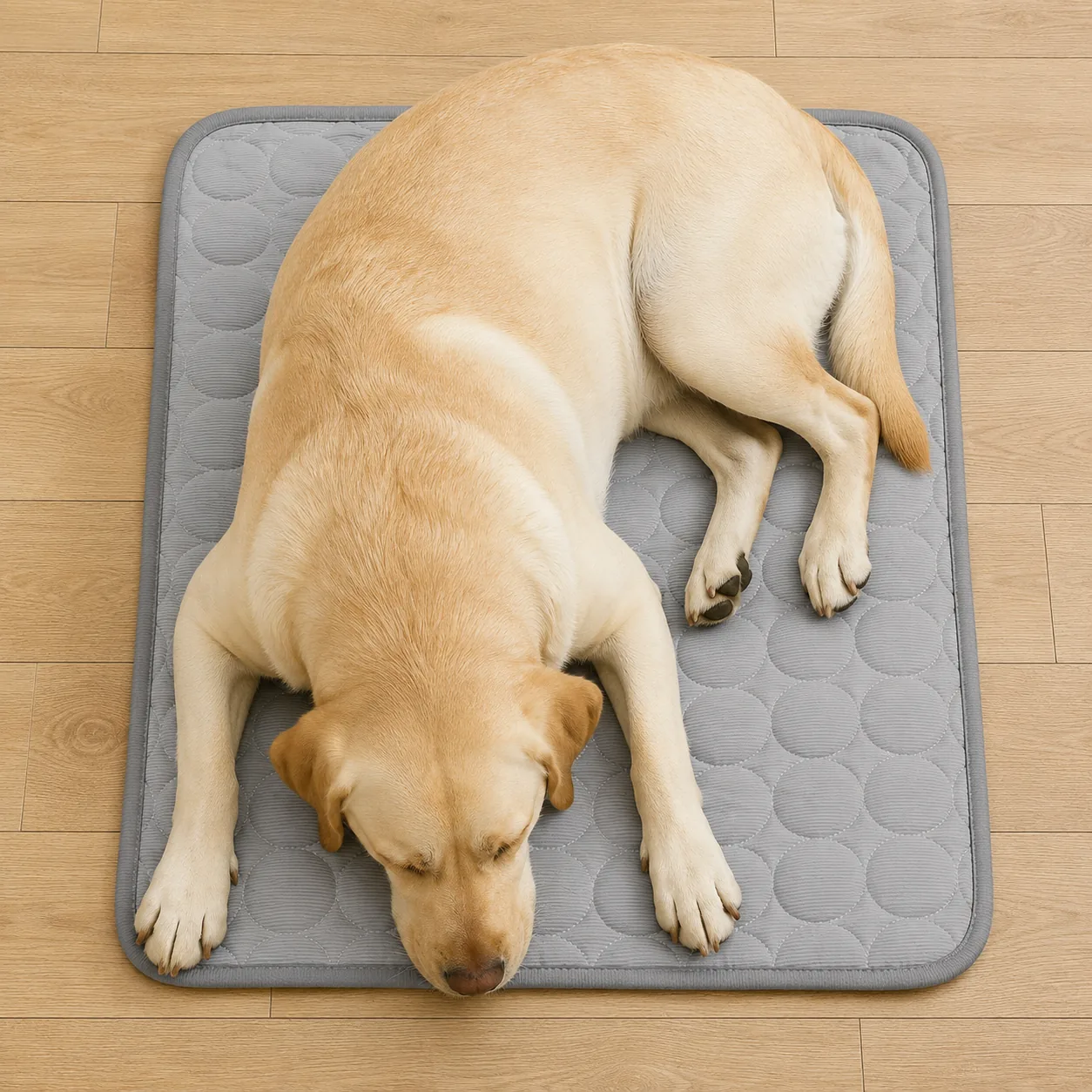
Floor-hunting with intent. Every dog has favorite napping spots. A dog that walks past all of them to lie on the bathroom tile, the hallway, or the strip of bare floor by the door is not being eccentric: it is looking for a surface that will take heat out through the belly, where the coat is thin. Scratching or digging at the bedding before giving up on it entirely is the same search.
Restlessness with a pattern. Lies down, gets up, moves, lies down again. Each patch of floor warms up underneath them, so they leave it for a fresh one. A dog circling the house for somewhere new to lie is telling you the surfaces are all losing the race.
The walk changes shape. Lagging behind on a route they usually lead, drifting toward every strip of shade, lying down mid-walk. None of it is stubbornness in warm weather; all of it is a dog rationing effort.
The bowl and the plate swap places. Drinking noticeably more while eating with less enthusiasm is a normal warm-weather shift, and it is also one of the earliest paired signs that the day is asking more of them than usual.
The flat-out posture. A hot dog lies stretched to full length, belly pressed to the floor, back legs out behind. More skin against a cool surface means more heat leaving. Once in a while, that is comfort; a whole afternoon of it is load management.
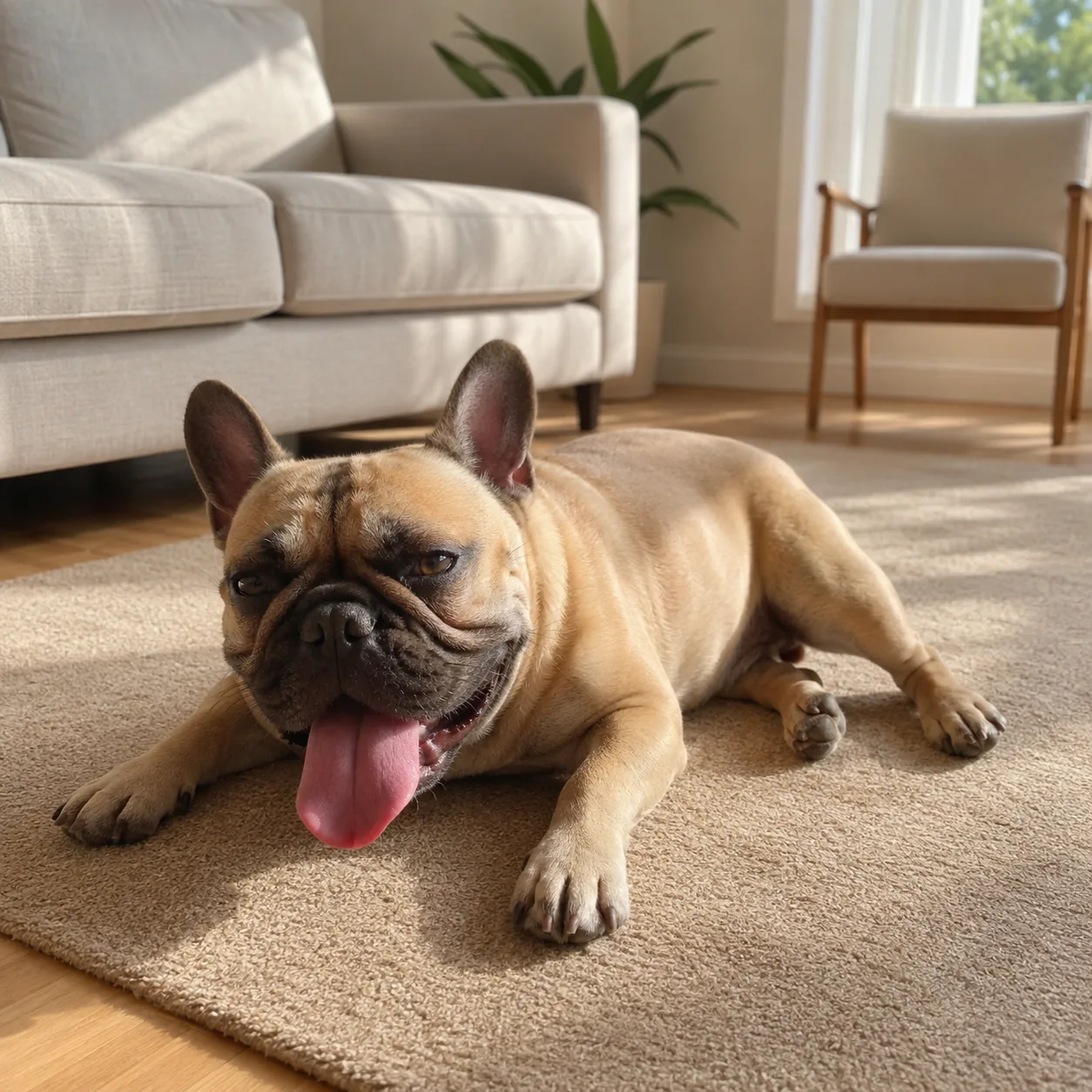
One warning about play: a driven dog will not read these signs for you. A ball-obsessed retriever keeps retrieving past the point it should stop, because drive overrides discomfort. During games in warm weather, the pauses are yours to schedule, and the settle test above is what you run during them.
When watching stops being enough
The gradation gives you the threshold. As long as the signs ease when you remove the cause, a cool room, water, rest, you are still in the early rows of the table, and what you are doing is working.
Call the practice when the clear-stage signs do not ease: panting at rest that carries on in a cool room, restlessness that will not break, drool and a wide tongue that stay after several quiet minutes. Describe what you are seeing over the phone: practices would rather hear about a dog one stage early than one stage late.
Go, without waiting to be sure, at any sign from the last row: relentless panting, bright red gums, wobbling, vomiting. The heatstroke guide covers the four first-aid steps and the four mistakes to avoid on the way, and the one rule that matters here is that cooling and calling happen together.
Which dogs give you the least warning
Every sign on this page appears earlier, and escalates faster, in some builds than in others. Flat-faced breeds pant loudly all the time, so the change in their panting is harder to hear, and their short muzzle makes the mechanism itself less effective: they reach the later rows of the table sooner. Double-coated and heavy dogs carry insulation and mass that slow heat loss, so their early stage can look deceptively calm.
Which breeds sit in which of those categories, and why, is laid out in which dog breeds struggle most in the heat. Age tilts the same way: older dogs regulate more slowly and their slowing down gets written off as age, which is exactly the mistake covered in senior dogs and cats in summer. Puppies and overweight dogs round out the list.
If your dog is on that list, treat the early row of the table as your cue rather than waiting for the clear one.
What the early signs ask you to change
Everything the early signs call for is ordinary: water in more places, walks at cooler hours, shade that is still there at noon, and a surface that takes heat away. The full list, in order of how much each one changes over a day, is in how to cool down a dog.
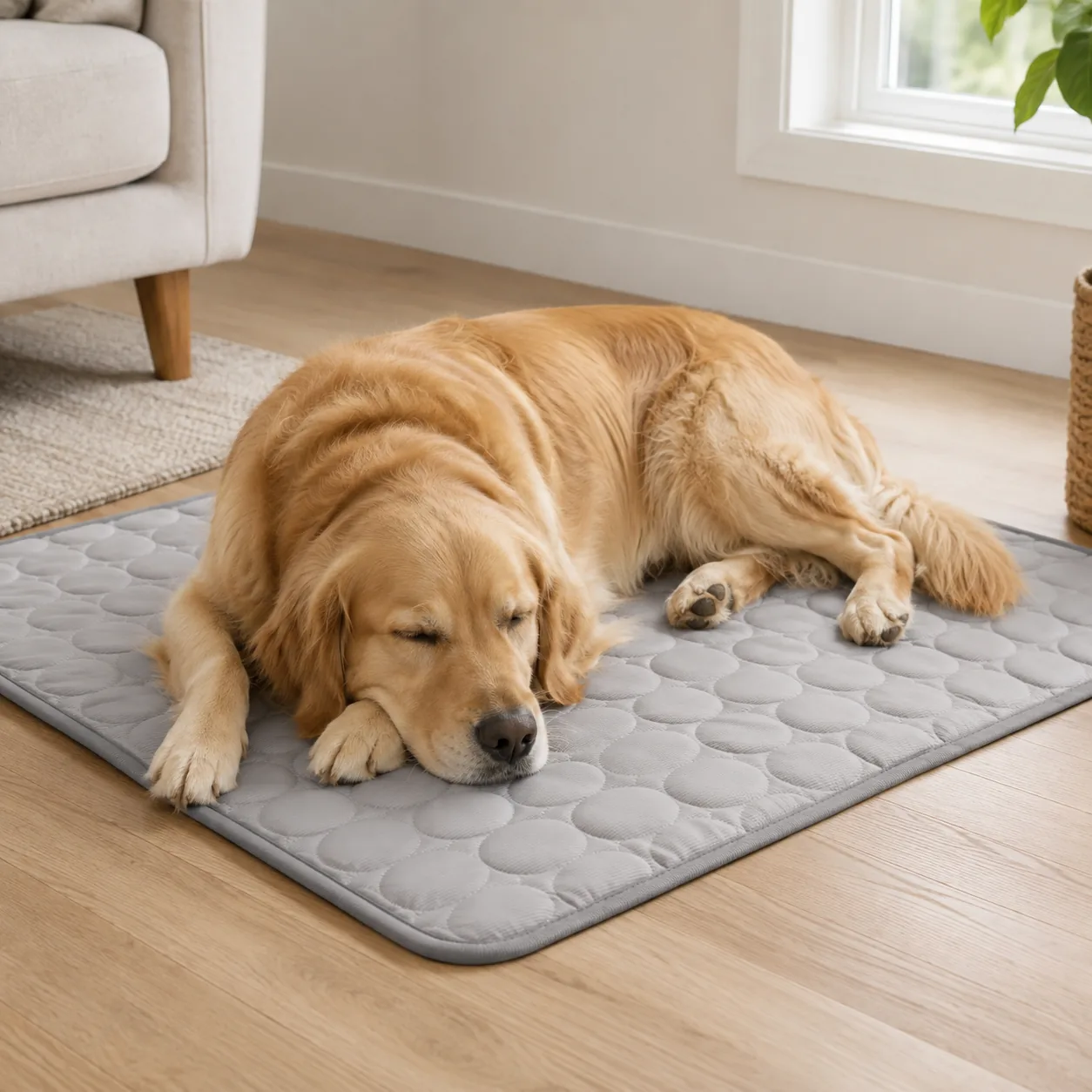
The surface deserves the last word here, because it answers the most common early sign directly. A dog sleeps twelve to sixteen hours a day, and a dog hunting for tile has already told you what it wants for those hours. A cooling mat is that surface, in the spot you choose rather than the coldest corner of the bathroom, and it works with no gel, no power and nothing to prepare. The physics, with the measurement behind it, is on the page about how cooling mats work.
Read early, the signs on this page stay small: a longer drink, a slower lap of the yard, an afternoon spent flat on something cool. That is the outcome to aim for, and it is mostly a matter of looking at amounts a day sooner.
Frequently asked questions
Is panting always a sign my dog is too hot?
No. Dogs also pant from excitement, stress and pain, and some pant more simply because of the shape of their muzzle. Heat panting comes with context: a warm day or recent effort, plus the quieter signs such as hunting for bare floor and drinking more. Panting at rest with no obvious reason is a question for your vet either way.
Do dogs stop playing when they get too hot?
Many do not, and that is the trap. A dog focused on a ball or another dog can keep going well past the point where it should stop, because drive overrides discomfort. The pauses are yours to enforce: shade, water, and a few quiet minutes. What you watch during those minutes is how quickly the panting settles.
How can I tell if my dog is too hot at night?
The signs shrink to sound and movement: audible panting at rest, getting up again and again, swapping the bed for bare floor, a wet patch of drool where they lay. Cooler room, water within reach and a surface that takes heat away usually settle it. Panting at rest that does not ease in a cool room is a call to the vet, at night too.
What is the difference between overheating and heatstroke in dogs?
Direction. An overheating dog is still coping: move them somewhere cool, let them rest, and the signs ease within minutes. In heatstroke the system is overwhelmed and the signs no longer ease, they build: relentless panting, bright red gums, unsteady walking, vomiting. That is an emergency, and cooling and the vet happen together, not one after the other.
This text does not replace veterinary advice. If what you are seeing matches the last row of the table, contact a veterinary practice straight away.
A cool spot, while the signs are still small
The surface your dog is already hunting for on a warm day. Four sizes, no gel and no power.
Free shipping to 18 countries · 30-day returns · We reply within 24 hours