
Walking a dog in hot weather: the risk most owners look for in the wrong place

Tessa Larkin · Writer, pet wellbeing and pet gear
Tessa lives with a Labrador and two cats on the Texas Gulf Coast, one of the hottest and most humid corners of the country in summer. For several seasons she has been testing, in real conditions, what actually helps animals through the heat and what only looks like it does.
Where heat cases in dogs actually start
The parked car campaign worked: most owners can recite it. What almost nobody has seen is the count of where the cases actually come from. Emily Hall, Anne Carter and Dan O'Neill published that count in Animals in 2020, using VetCompass, the veterinary records programme run by the Royal Veterinary College. They went through the primary care records of 905,543 dogs and pulled out 1,259 heat-related illness events across 1,222 dogs. For 879 of them the vet had recorded what set it off.
| What triggered the episode | Share of the 879 cases with a recorded trigger |
|---|---|
| Exertion: walking, running, playing | 74.2 percent (652 cases) |
| A hot environment around the dog | 12.9 percent (113 cases) |
| Confinement in a vehicle | 5.2 percent (46 cases) |
| Under veterinary or grooming care | 4.6 percent (40 cases) |
| Confinement in a building | 2.7 percent (24 cases) |
Then the authors looked inside the exertion row. Of the 551 exertional cases where the activity was written down, 372 followed a walk, or 67.5 percent. Running or cycling alongside accounted for 97, games for 76. Not a dog sport, not a heatwave hike. A walk.
Deaths followed the same shape: 32 from exertion against 4 from vehicles, which the authors describe as eight times as many deaths overall. The odds of death per case showed no significant difference between the two, so nothing here makes one kind of case milder. The difference is how often each happens, and what it takes to end up in the top row: an ordinary route on an ordinary warm day.
Why a walk loads a dog twice
A dog on a warm day is already running its cooling system at part throttle. Ask it to walk and you add to both sides of the balance at once.
Movement makes heat. Working muscle produces it, and the only real way a dog sheds it is panting, which is itself muscular work. Because panting runs on evaporation it loses power as the air gets more humid, so a muggy day asks more than a drier one that reads warmer on the thermometer.
The walk removes the alternative. At home a dog regulates by going somewhere: the hall tile, the shaded doorway, the coolest corner of the kitchen. On a route that option is gone. The dog goes where the leash goes, at the pace the leash sets, on whatever the ground is made of.
Put those together and the picture stops being about the thermometer. It is why the study found cases in every month of the year, July the largest at 426 events. A cool-looking day with a normal walk in it can still produce one.
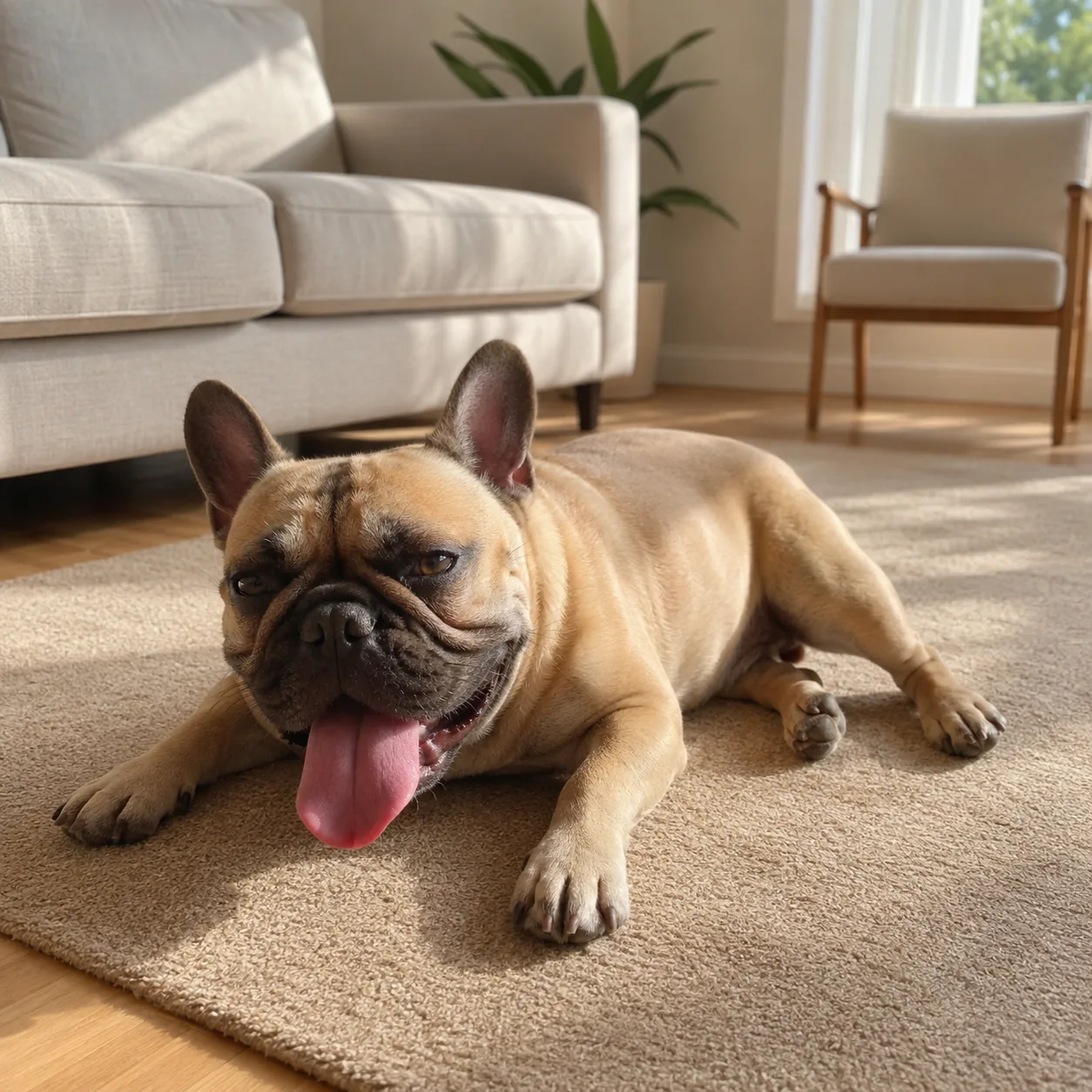
Hot pavement: the heat source under a walking dog
The ground is the part of the walk that owners feel least and dogs feel most. We walk on it through shoes. A dog walks on it through bare pads, with the thin-coated underside of the body just above a surface that has been absorbing sun all day, at the moment it is trying to shed heat.
The five-second check with the back of your hand, and the temperatures that ground reaches, are on the page about how to cool down a dog, which also sets out the hours to walk in. Three things about the ground belong here instead, because they change the route rather than the timing.
The ground runs late. Air cools quickly once the sun is off it. Dark, dense surfaces do not: asphalt keeps giving back what it took in for hours afterward. So the air can feel like the day has broken while the street underneath has not caught up. The hour on the clock is not the measurement. The hand on the ground is.
The surface is a choice. Grass, packed earth, woodland floor and shaded side streets all sit below open asphalt on the same afternoon. On most routes there is a version of the walk that stays off the hot stuff.
Height decides the dose. A small dog, a puppy or a low-slung breed walks in a thin layer of air the ground is actively heating; a tall dog walks above it. The same route is not the same walk for a Dachshund and a Setter. Age tilts it further, and that is in senior dogs and cats in summer.
Your dog will not call the walk off
A dog does not ration itself. Given a ball, another dog or a familiar route, it will keep going well past the point where a person would sit down, because drive overrides discomfort. The study is a record of that: hundreds of walks that started normally and were not stopped in time. The decision belongs to the person at the other end of the leash.
In practice that is small and unglamorous. You set the length before you leave rather than at the far end of the route. You take the pauses in shade instead of pushing on to the corner, and you watch how fast the panting settles during them. When it does not settle, the walk is finished, whatever was planned.
The full reading of those signs is in how to tell if a dog is too hot. What matters on the walk is that the first one is a change of pace rather than anything dramatic: lagging on a route your dog normally leads, drifting toward shade, lying down halfway.
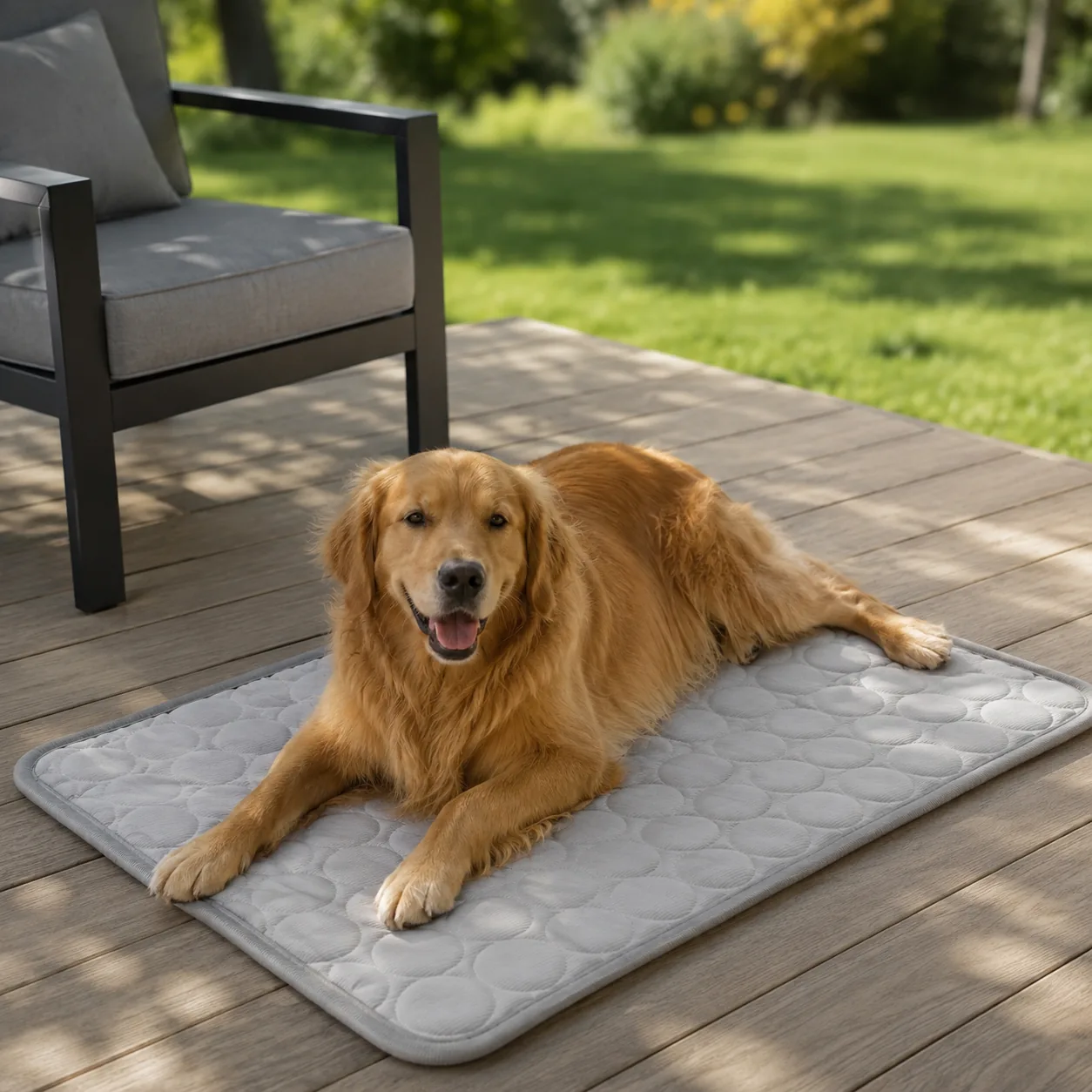
The builds that get into trouble on an ordinary walk
The same study ran the odds of exertional heat-related illness by breed type, against Labrador Retrievers as the baseline. Seven came out significantly higher: the Chow Chow, at seven times the odds, then the Bulldog, the French Bulldog, the Greyhound, the English Springer Spaniel, the Cavalier King Charles Spaniel and the Staffordshire Bull Terrier. Brachycephalic dogs had greater odds of all three main types of case.
That list sorts by neither size nor coat length. A short muzzle moves less air, so the one cooling route a dog has is narrower before the walk even starts. Two of those breeds are working dogs whose problem is drive rather than build: they will run the walk you offer, and then some. Which trait applies to which build is in which dog breeds struggle most in the heat.
If your dog is on that list, the walk is what you plan first on a warm day rather than what you fit in.
What replaces the walk you decided to shorten
Cutting the walk is the easy half. The hard half is the rest of the day, because a dog with energy and nowhere to put it is what makes owners go anyway. Two things fill the gap. The first is work that tires a dog without producing the heat that movement in the sun does: scent games down the hall, kibble scattered in a towel, training in short sets, a stuffable toy out of the freezer. Nose work empties a dog in a way the same stretch of pavement does not.
The second is a place to do nothing on. A dog sleeps twelve to sixteen hours a day, and on a hot afternoon it spends most of them hunting for a surface that will take heat out through the belly, where the coat is thin and the skin meets the floor. That hunt is why dogs end up on bathroom tile. A cooling mat is that surface, put where you want the dog to settle rather than in the coldest corner of the house, with no gel and no power. The physics, with the measured figures, is on the page about how cooling mats work. It gives the shortened day somewhere to go: a spot the dog chooses on its own, in the room you are in.
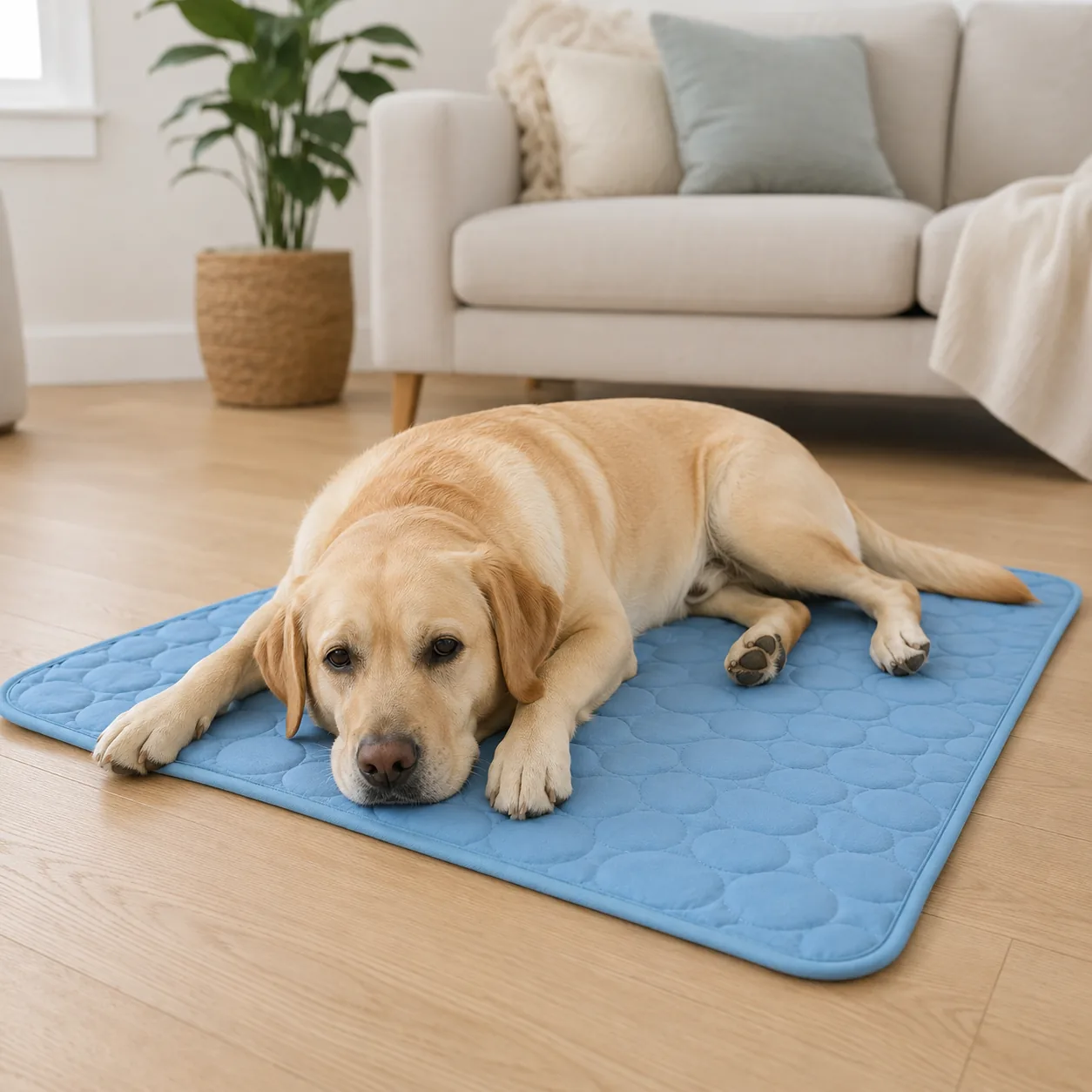
The ten minutes after you get back
The walk does not end at the door. A dog that has been working in warm air keeps producing heat after it stops, and those first minutes indoors are where a warm walk either settles or does not.
Put three things within reach and let the dog use them: water in more than one place, air moving through the room rather than pointed at the dog, and a cool surface at floor level that saves a tired dog the job of hunting the house for one.
Then run the same check you ran on the walk. Panting that winds down over a few quiet minutes is the system doing its job. Panting that holds the same rate, or restarts the moment your dog lifts its head, means the heat is still winning.
What to do at that point is not on this page, deliberately. It is in the guide to heatstroke in dogs, which carries the first-aid steps as published by the RSPCA, including the one that decides the most: cool first, transport second.
What the study actually changes
Not the car rule. That one is fixed, it stays exactly where it is, and every campaign that repeats it is right to. What the study changes is the length of the list beside it, because the most common trigger was missing: the thing owners do on purpose, every day, thinking of it as the good part of the dog's routine.
That is not an argument for skipping walks. It is an argument for the walk being a decision on a warm day rather than a habit: the hour, the ground, the length, the pace, and something at home to come back to.
Frequently asked questions
Is it safe to walk my dog in hot weather?
Walking is not the problem, the conditions around it are. The walk is where most heat cases begin, so it is the part of the day to plan rather than run on habit: cooler hours, shaded routes, water with you, an easier pace. If your dog slows, drifts toward shade or lies down, the walk is already over.
Is the evening walk automatically the cooler one?
Not by itself. Air cools faster than ground does, so a street can still be giving back the heat it took in all afternoon while the thermometer says the day has broken. A hand on the ground tells you that before you set off.
Which is more dangerous for a dog, the walk or the hot car?
Both, and that is the point. Leaving a dog in a parked car is a rule with no exceptions and it stays one. What the UK study adds is that exertion triggered far more cases than vehicles did and caused more deaths in total, while the odds of death per case showed no significant difference between the two. Nothing replaces the car rule. It is the walk that was missing from the list.
Does a shorter walk mean my dog is getting too little exercise?
It means the same energy goes somewhere else. Scent games in the hall, training in short sets, a stuffed toy from the freezer and food that has to be worked for all tire a dog without adding the heat that movement in the sun does. Give that a cool surface to recover on and a shortened walk stops being a day spent waiting.
Case figures: Hall EJ, Carter AJ, O'Neill DG, "Dogs Don't Die Just in Hot Cars: Exertional Heat-Related Illness Is a Greater Threat to UK Dogs", Animals, 2020, 10(8), 1324, using VetCompass data from the Royal Veterinary College. First-aid guidance as published by the RSPCA. This text does not replace veterinary advice. If you suspect heatstroke, contact a veterinary practice or an emergency service straight away.
Somewhere cool to come back to
The surface a dog goes looking for after a walk in warm weather. Four sizes, no gel and no power.
Free shipping to 18 countries · 30-day returns · We reply within 24 hours